

A marble dining table can survive years of daily use and crack during one awkward lift. A glass tabletop can reach the truck without a scratch, then break when its exposed edge touches metal.
The risk comes from how the top is supported, separated and secured. When planning a move in Ras Al Khaimah, these details need attention before packing starts. Here is how to move a marble table or glass top with less risk, from checking the base connections to protecting the edges and preparing the vehicle.
How Do You Move a Marble or Glass Tabletop Without Cracking It?
Move a detachable tabletop using suitable lifting equipment, protected edges and a purpose-built transport frame. Large slabs are generally transported on edge with proper support. Follow the manufacturer’s handling instructions, especially for bonded, repaired or unusually shaped tops.
Plan the job in 6 steps:
- Inspect the tabletop. Photograph its surface, underside, edges and existing damage before covering it.
- Check the construction. Identify whether the top rests on pads, uses removable fixings or is permanently bonded.
- Measure the route. Check door openings, stair turns, lift dimensions and the loading entrance.
- Prepare the support. Have the correct lifting equipment, padded resting supports and transport frame ready.
- Protect and move the top. Use a coordinated crew and avoid twisting, dragging or placing weight on one corner.
- Secure and inspect it. Restrain the load before departure and check its condition before reassembly.
A blanket protects the finish but does not provide structural support. Likewise, adding more people does not automatically make a difficult lift safe. The crew needs enough room to grip, turn and lower the tabletop together.
For a large, cracked or previously repaired slab, arrange specialist assessment before attempting movement.
Why Can Marble Crack Near the Apron and Legs?
Marble can crack near the apron and leg supports when uneven lifting concentrates stress around those connections. However, this is not a universal failure point. The risk depends on the table’s construction, support pattern and existing condition.
The apron is the frame beneath the tabletop that connects the legs. During normal use, it helps distribute the load. During a move, one person lifting ahead of another can twist that frame. A rigidly attached stone top may then experience forces it was not designed to accommodate.
Three details deserve attention:
- Unsupported overhangs: projecting sections can experience bending when used as lifting points.
- Mounting locations: brackets, inserts and attachment holes can concentrate forces.
- Previous repairs: filled cracks or repaired joints may require additional support.
A visible marble vein is not automatically a crack. Equally, a polished surface does not prove that the underside is sound. Check both faces and ask about previous repairs.
Do not test the table by rocking it or lifting one corner. Identify the attachment method first, then plan support around the actual construction.
Why Can Flat Transport Cause Failure?
Flat transport can cause failure when a tabletop spans unsupported gaps and bends under its own weight or vehicle movement. The problem is inadequate support, not simply the fact that the surface is horizontal.
A dining table normally rests on a base designed for its shape. Inside a truck, two furniture stacks or a pile of blankets cannot reliably reproduce that support. Braking, vibration and uneven roads can change where the load bears against the surface.
For large detachable slabs, a suitable transport frame generally holds the top on edge, with padded support beneath and behind it. That arrangement still needs to match the material, dimensions and weight.
Avoid these three loading shortcuts:
- Laying the top across cartons that can compress.
- Placing other furniture or boxes on its face.
- Standing it loosely against a truck wall.
A manufacturer-approved crate may use a different arrangement. Follow that specified packing system rather than forcing every tabletop into the same position.
For marble dining table moving, establish the transport method before dismantling. Otherwise, the crew may have a detached slab with nowhere safe to place it.
How Do You Separate the Top From the Base?
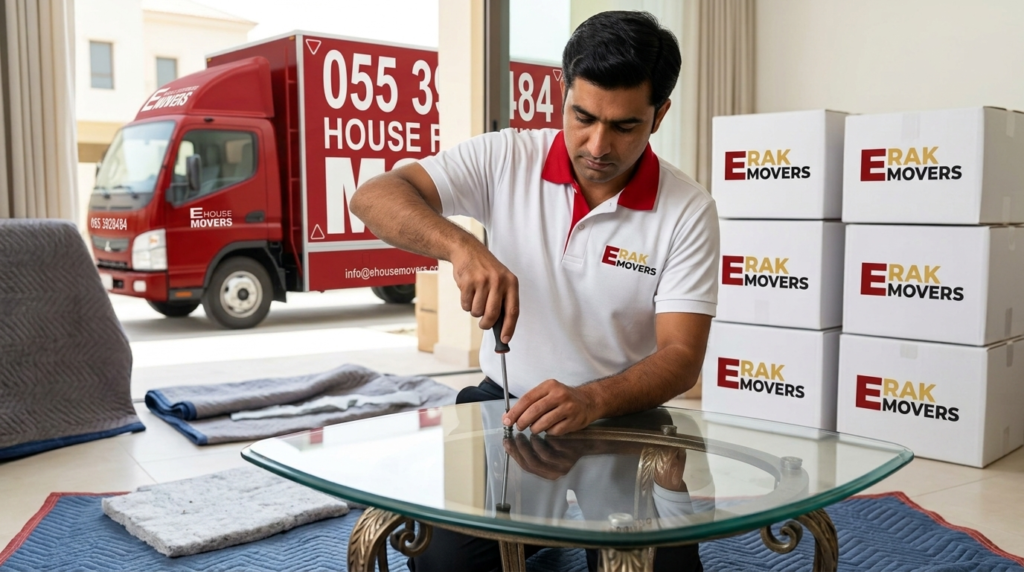
Separate the top from the base only when the table is designed for removal and its weight can be supported throughout the process. Do not assume every marble or glass top lifts off.
Identify the Connection
Inspect the underside with adequate lighting. Look for bolts, brackets, retaining clips, support pads or adhesive bonds.
Photograph each connection before loosening anything. Manufacturer instructions are particularly useful when fasteners are concealed beneath decorative covers.
A glass top may rest on rubber pads, but another may be bonded to metal mounting plates. Those designs require different handling.
Support the Top Before Releasing It
Prepare the receiving support and lifting equipment before removing the final fixing. Nobody should need to hold the tabletop while another person searches for blankets or tools.
Use suction equipment only when it is suitable for the material, surface condition, load and lifting orientation. Ordinary household suction handles are not a substitute for rated lifting equipment.
Remove Only the Intended Fixings
Release removable connections according to the manufacturer’s sequence. Keep the hardware in a labelled bag and transport it separately from the polished surface.
Stop when a connection resists unexpectedly. Do not pry stone or glass away from adhesive using a screwdriver, blade or improvised lever. A bonded top may need a furniture technician or fabricator.
Move the Base Separately
Dismantle the base where its design allows. Protect exposed brackets and keep them away from the packed tabletop.
At the destination, assemble and stabilise the base before returning the top to position.
How Do You Protect the Edges and Corners?
Protect the edges and corners with suitable cushioning and rigid outer protection before the tabletop leaves the room. Face wrapping alone leaves the most exposed contact points vulnerable.
Start with a clean, dry surface. Dust or grit trapped beneath wrapping can scratch the finish as the package moves.
Build protection in four stages:
- Cover the faces. Apply a clean, non-abrasive layer compatible with the finish.
- Cushion the perimeter. Fit edge protection around the full outline, including curved sections.
- Protect projecting corners. Use properly fitted corner guards without creating concentrated pressure.
- Add outer protection. Use an appropriate rigid cover or custom crate where the assessment requires it.
Keep adhesive tape off polished stone, coatings and decorative finishes unless the manufacturer confirms compatibility. Secure the wrapping to itself.
Round tabletops need perimeter protection too. Their curved edges can roll or slip without a correctly designed support.
Label the package with its contents and handling orientation. Marking “Fragile” helps identify the load, but it does not prevent another item from falling against it. Physical separation and restraint remain necessary.
How Do You Secure the Tabletop in the Vehicle?
Secure the tabletop in a rated transport frame or suitable crate, then secure that assembly to appropriate vehicle anchor points. A padded wall alone is not a transport system.
The loading plan should address four separate risks:
| Risk | Required protection |
|---|---|
| Sliding along the floor | Suitable base support and restraint |
| Tipping sideways | A stable frame with lateral restraint |
| Striking nearby cargo | Separation and independently secured neighbouring items |
| Damage from straps | Compatible padding, edge protection and controlled restraint |
Straps should hold the load without bending the tabletop or pressing hardware against its face. Excessive tension can create damage rather than prevent it.
Keep metal buckles and hooks away from exposed surfaces. Do not use the tabletop to restrain another item, and do not lean furniture against its package.
Check the unloading route before releasing restraints. The receiving crew, equipment and resting supports should already be ready. Nobody should stand where a slab could fall or attempt to catch it if it tips.
A short journey within Ras Al Khaimah still needs proper restraint. Loading, braking and unloading all place demands on the support system.
How Do Glass Tabletops Differ From Marble?
Glass and marble differ in their construction and failure behaviour. Glass does not always shatter in the same way, and marble does not always show an obvious warning before breaking.
| Material | Main handling concern | What to check |
|---|---|---|
| Marble | Bending, concentrated loads and existing weaknesses | Repairs, underside reinforcement and support locations |
| Annealed glass | Breakage that can produce large, sharp fragments | Edge chips, scratches and attachment details |
| Tempered glass | Sudden breakage, particularly following damaging edge impact | Manufacturer identification and edge condition |
| Laminated glass | Cracking despite fragments being retained by an interlayer | Interlayer construction and manufacturer instructions |
When moving a glass table top, do not assume thickness makes it safe to handle casually. Its dimensions, edge condition and mounting method also matter.
Keep hands clear of pinch points when lowering either material onto its base. Replace missing or damaged support pads with suitable replacements before installation. Do not improvise with uneven pieces of cardboard.
After reassembly, inspect the top and its connections before placing objects on the table.
Plan the Tabletop Move Before Packing Day
A safe tabletop move starts with knowing how the piece is built. Confirm whether the top detaches, how it will be supported and whether the protected package fits the full route. Packing materials should be selected around that plan.
When arranging furniture movers in Ras Al Khaimah, share photographs of the tabletop, underside, base connections and access route. Include its dimensions and disclose any previous repairs.
Contact RAK E Movers before moving day to discuss the item and request a handling assessment. Agree on dismantling, protection, transport support and reassembly in the written quote, while there is still time to prepare the right equipment.