

A piano may fit through the living-room door and still get stuck at the next turn. Its weight makes that problem difficult to correct once the move has started. An unsuitable trolley, an unmeasured staircase or pressure on a delicate component can damage both the instrument and the property.
Moving a piano in Ras Al Khaimah starts with checking the instrument and the complete access route. This guide explains the equipment, differences between upright and grand pianos, crew planning, quotation details and aftercare that need attention before moving day.
How Do You Move a Piano in Ras Al Khaimah?
Move a piano with a specialist crew, equipment selected for its model and weight, and a measured access route. Protect the instrument, dismantle only where required, secure it inside the vehicle, and prepare its destination before unloading.
The process has six stages:
- Identify the piano. Record its brand, model, dimensions and manufacturer-listed weight where available.
- Inspect its condition. Photograph the case, legs, pedals and existing marks. Note any loose parts or known mechanical problems.
- Survey both properties. Check the route from its current position to its final room, including loading access.
- Prepare the instrument. Secure moving parts and protect the finish using materials suitable for that piano.
- Move and restrain it. Use appropriate handling equipment and secure the load to suitable vehicle anchor points.
- Reassemble and inspect it. Position the piano, check its stability and arrange any necessary technician visit.
Do not lift an acoustic piano by its keyboard assembly, lid or pedals. Its small castors should not be treated as transport wheels for thresholds, ramps or long distances.
For homeowners, the useful preparation is clearing the route and supplying accurate information. The lifting and any dismantling should be handled by people experienced with the instrument.
What Equipment Does a Piano Move Require?
A piano move requires load-rated handling equipment, protective materials and a suitable vehicle. The exact equipment depends on the piano’s construction and the route.
A grand piano may need a padded piano board or skid. An upright may use a suitable piano trolley or dolly. These are not interchangeable with an ordinary household furniture trolley.
| Equipment | Purpose |
|---|---|
| Appropriate piano board or skid | Supports the instrument in its planned transport position |
| Load-rated piano dolly | Provides controlled movement across suitable level surfaces |
| Padded covers and moving blankets | Protect the case against rubbing and minor contact |
| Suitable restraint straps | Secure the instrument without loading delicate components |
| Rated tail lift or loading ramp | Provides a planned transition into the vehicle |
| Floor and threshold protection | Protects the property while maintaining a stable route |
Equipment capacity must cover the actual load. A tail lift assessment should account for everything placed on its platform, not just the piano.
Stair access may require specialist handling equipment or a different lifting method. That decision belongs in the survey, before the crew arrives.
Wrapping also needs care. Keep adhesive tape away from polished finishes, and avoid loose material that can snag beneath wheels. Protective covers cannot compensate for an unstable support or an unsuitable loading method.
How Do Upright and Grand Pianos Differ to Move?
Upright pianos are generally transported upright, while grand pianos commonly require specialist preparation involving removable legs and the pedal lyre. The correct method depends on the model and manufacturer’s instructions.
Moving an Upright Piano
An upright has a tall case and concentrated weight. Its shape makes balance important when crossing thresholds or changing direction.
The crew must use suitable support points and control the instrument throughout the route. Moving it onto equipment is a planned operation, not a matter of pulling it forward by the keyboard.
A narrow hallway may allow straight passage but leave insufficient space for the turn into the entrance lobby. Measure both.
Moving a Grand Piano
A grand has a wider body and a different support arrangement. Preparation commonly includes securing the lid and removing the pedal lyre and detachable legs before supported transport on a piano board.
This is specialist work. The instrument must be supported before a load-bearing component is released. Removing parts in the wrong sequence can destabilise it.
At the destination, the crew needs enough clear space to restore the supporting components safely. Do not leave reassembly until the room is crowded with cartons and furniture.
Moving a Digital Piano
A digital piano does not contain the same acoustic structure as an upright or grand. Some models separate from their stands, while cabinet-style models need different preparation.
Confirm the exact model rather than booking every instrument under the description “piano.”
How Many Crew Members Does a Piano Move Need?
The crew size depends on the piano, access conditions and handling equipment. There is no reliable rule that every upright needs four people or every grand needs five.
A level route with suitable mechanical assistance presents a different job from a staircase with a restricted landing.
| Move situation | What determines the crew requirement |
|---|---|
| Upright with level access | Weight, doorway clearance, dolly and loading method |
| Upright with stairs | Step geometry, landings, equipment and available working space |
| Grand piano | Preparation method, board handling and reassembly requirements |
| Large grand or difficult access | Specialist lifting plan and property constraints |
| Digital piano | Whether the keyboard and stand separate safely |
Ask the mover to explain how the proposed crew and equipment match the route. An answer based only on distance or bedroom count misses the main handling risks.
More people cannot solve every access problem. A crowded landing may leave less room to control the instrument. When the route is unsuitable, the plan must change.
How Is the Access Route Planned for a Piano?
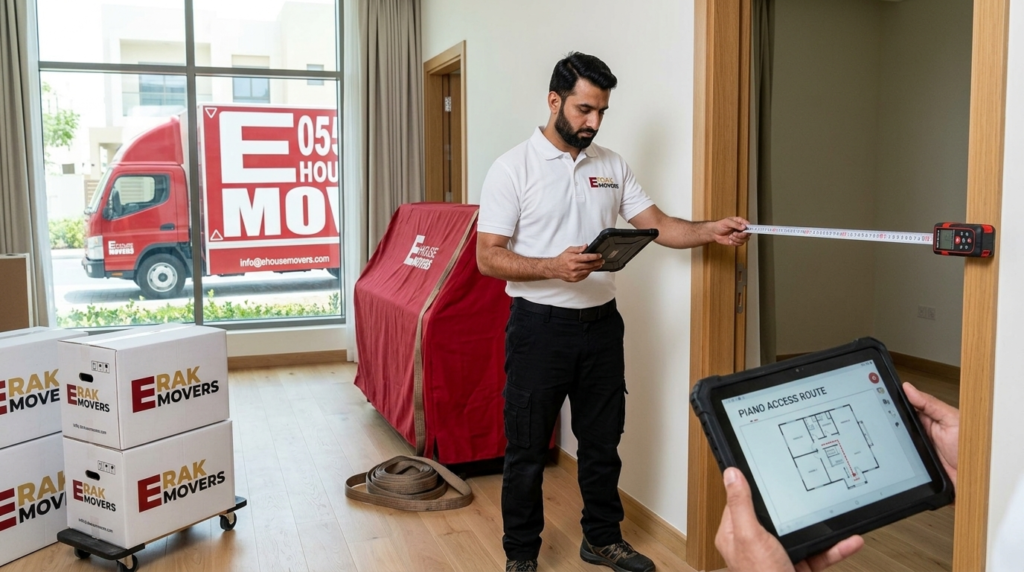
Plan the access route by measuring every doorway, turn, threshold and lift between the piano and the vehicle, then repeat the assessment at the destination.
Measure the instrument in its expected protected transport configuration. Covers, a board and handling equipment can increase the space required.
Check Doorways and Turns
Record clear opening widths rather than nominal door sizes. Handles, door closers and projecting frames reduce usable space.
Check the approach to each opening too. A piano may fit through a doorway but lack enough room to align with it.
Check Lifts and Stairs
For a lift, confirm the door opening, cabin dimensions and rated capacity. Account for the piano, equipment and anyone travelling with the load.
For stairs, record the width, landing dimensions, headroom and handrail position. Photographs help, but a difficult staircase may need an on-site assessment.
The same building-access checks that affect moving costs also help identify whether specialist handling is needed.
Check Parking and Building Arrangements
Confirm where the vehicle can stop and whether the loading equipment can operate there. Steps between the entrance and parking space still matter, even when the property is described as ground-floor.
For an apartment move in Ras Al Khaimah, ask management about service-lift availability and any required moving arrangements. Confirm the actual building’s requirements rather than assuming every development follows the same process.
What Does Piano Moving Cost in Ras Al Khaimah?
Piano moving costs in Ras Al Khaimah require an item-specific quote. The piano type, access route and handling method determine the work more accurately than distance alone.
A useful quotation should explain these components:
| Cost component | What the written quote should clarify |
|---|---|
| Piano handling | Instrument type and agreed scope |
| Preparation and reassembly | Which components require removal and refitting |
| Access work | Stairs, restricted turns or extended carrying distance |
| Specialist equipment | Any additional lifting or handling equipment |
| Transport | Collection, delivery and any intermediate storage |
| Protection | Covers, packing or crating where needed |
| Insurance | Applicable cover, limits and exclusions |
| Additional charges | Taxes and any agreed waiting or access charges |
When comparing piano moving costs in the UAE, compare matching jobs. A level-access upright transfer is not equivalent to grand piano relocation involving stairs.
Send the model, photographs, dimensions and access details before requesting a final figure. Ask whether the quoted price changes if the disclosed conditions remain unchanged.
Do not assume tuning is included. Confirm it separately.
Why Should a Piano Be Checked and Tuned After Moving?
An acoustic piano should be checked after moving because its new environment may affect tuning and playing response. Changes in humidity and temperature can influence its wooden components and string tension.
Transport does not automatically mean the frame has “settled” or that the instrument has suffered damage.
Position the piano away from direct sunlight, moisture and strong air-conditioning airflow. Aim for stable room conditions rather than alternating between prolonged heat and intense cooling.
Ask a qualified piano technician when to schedule tuning. The appropriate timing depends on the instrument and the change in its surroundings, so a fixed waiting period does not suit every move.
Report sticking keys, unusual noises, loose pedals or visible damage promptly. Do not assume those problems will disappear after tuning.
Digital pianos do not require acoustic tuning, but their connections, pedals and stand stability should still be checked.
Give the Piano Its Own Moving Plan
A piano needs a handling plan before the rest of the room is packed. Confirm the model, inspect both access routes and agree on equipment, preparation and pricing in writing.
When comparing furniture movers in Ras Al Khaimah, ask specifically about experience with your piano type and whether specialist support is required.
Contact RAK E Movers with photographs of the instrument and both properties. Request an assessment of the handling requirements and a written quote before confirming the booking. That gives everyone time to resolve access problems before the piano leaves its position.