

A cabinet can arrive without a dent and still have marks pressed into its lacquer. A sofa can be heavily wrapped yet develop problems because it was packed while damp. Protecting furniture starts with choosing what touches the surface.
Different finishes need different treatment. This guide matches packing materials to wood, leather, upholstery, stone, artwork and glass. It also explains the order of protective layers and the materials to keep away from sensitive surfaces when moving in Ras Al Khaimah.
Which Packing Material Belongs on Which Surface?
Choose the first-contact material according to the surface’s finish, condition and sensitivity. Then add cushioning, edge protection and structural support as needed. For flaking paint or fragile gilding, the safest arrangement may keep packaging away from the decorated surface altogether.
Use this matrix as a starting point for sound household items. Manufacturer instructions and a specialist condition assessment take priority.
| Surface | First-contact approach | Additional protection | Main concern |
|---|---|---|---|
| Sound polished or lacquered wood | Clean, smooth, non-abrasive interleaf selected for the finish | Padded blanket and protected corners | Scratching, sticking and pressure marks |
| Unvarnished wood | Clean, undyed, non-abrasive material suitable for the wood | Blanket or fitted cushioning | Dirt, staining and abrasion |
| Sound leather upholstery | Clean, soft, undyed fabric cover compatible with the finish | Loose protective padding where required | Colour transfer, trapped dampness and compression |
| Fabric upholstery | Clean, dry furniture cover suitable for the fabric | Padding around exposed frame sections | Soiling, snagging and crushed pile |
| Marble and stone | Clean, compatible interleaf at contact points | Suitable foam supports, protected edges and rigid support where needed | Chipping, staining and bending |
| Exposed painted artwork | Keep wrapping clear of the paint surface | Travel frame or suitable stand-off protection | Adhesion, abrasion and loss of paint |
| Gilded or ornamented frames | Avoid contact with unstable decoration; assess sound areas individually | Supports positioned against structurally sound areas | Detached gold leaf or broken ornament |
| Plain glass and mirrors | Clean, non-abrasive cushioning compatible with coatings | Edge guards and a fitted rigid outer container | Scratches, edge impact and bending |
Material compatibility matters beyond softness. Conservation guidance warns that packaging can leave impressions, transfer residues or react with surfaces; tape should attach to the wrapping rather than the object.
What First-Contact Material Means
First-contact material is the layer that directly touches the item. It separates the surface from the stronger materials used outside it.
A packing system generally has 3 functions:
- Surface separation
- Cushioning
- Structural protection
One material rarely performs all three functions well. A thin fabric cover may keep a chair clean but offers little impact protection. A rigid crate may resist outside pressure while still allowing damage if the item moves inside.
Before wrapping, inspect the item under good light. Record scratches, cracks, loose trim, repairs and unstable finishes. Ask whether the furniture was recently painted, polished or reupholstered.
If the surface is tacky, powdery, peeling or unusually delicate, pause before covering it. Even a normally suitable material can catch on loose decoration or become attached to a soft finish.
Which Material Suits Polished and Lacquered Wood
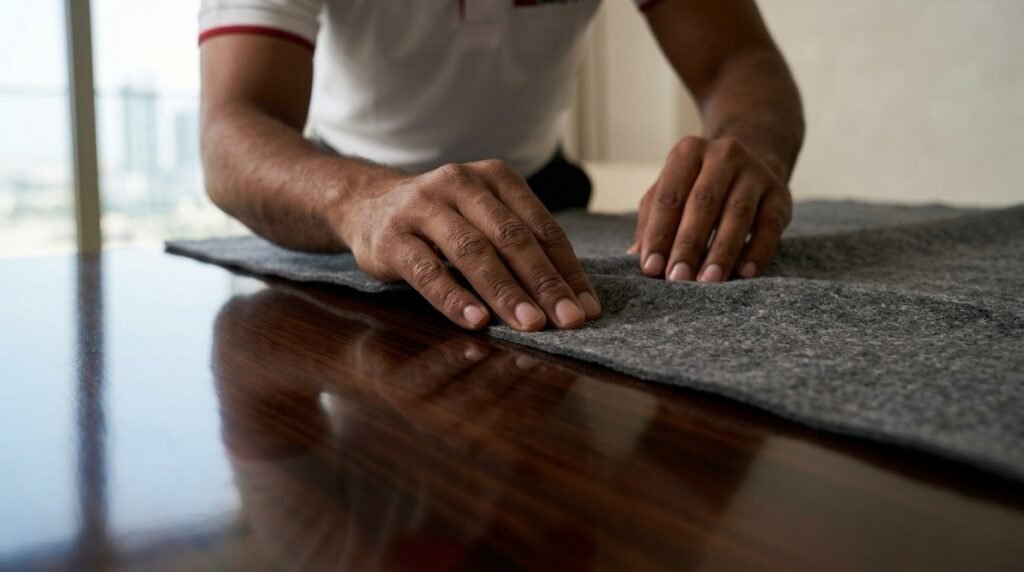
Sound polished and lacquered furniture needs a clean, compatible contact layer beneath its heavier protective wrapping. Check the finish before placing a moving blanket directly against it.
For a stable cabinet, table or sideboard, the packing sequence should address the surface and vulnerable projections separately:
- Select a smooth, non-abrasive contact material.
- Add clean padded protection around the furniture.
- Protect corners, handles and projecting sections without pressing them into the finish.
- Secure the outer wrapping without attaching adhesive to the furniture.
Inspect blankets for grit, staples and rough seams. A dirty blanket can carry abrasive particles against an otherwise sound surface.
Do not stretch plastic tightly over a glossy tabletop as a default packing method. Packaging can stick to temperature-sensitive finishes or leave impressions, particularly when unsuitable materials remain in contact under pressure.
Recently refinished furniture needs advice from the person who applied the coating. “Dry to the touch” does not establish that a finish is ready for tight wrapping.
Unvarnished wood also needs care. Avoid printed, dirty or damp materials against it, and do not apply furniture polish simply to prepare it for transport. Explain the wood’s condition during the survey so the packing method matches the actual piece.
Which Material Suits Leather and Upholstery
For sound leather and fabric upholstery, start with a clean, dry cover that will not mark, snag or transfer colour to the surface. Add protection according to the sofa or chair’s shape.
Leather finishes vary. Smooth coated leather, suede and older leather with a deteriorating surface should not receive an identical treatment. Flaking leather needs assessment before wrapping because contact itself may remove material.
For ordinary household upholstery:
- Allow recently cleaned furniture to dry fully.
- Use clean, undyed contact fabric where suitable.
- Protect exposed wooden feet and frame sections separately.
- Avoid tightening straps across cushions or decorative details.
- Keep sharp packing closures away from the upholstery.
Cotton fabric and acid-free tissue are among the materials used in leather conservation, but suitability depends on the object and its condition.
Plastic is not automatically unsuitable in every outer packaging system. The concern is direct contact, trapped moisture, pressure and how long the furniture remains wrapped. Do not tightly seal a damp sofa and assume the covering will keep it safe.
For velvet or other pile fabrics, avoid packing pressure that flattens the visible surface. Ask the mover how the piece will be supported and restrained inside the vehicle.
Which Material Suits Marble and Stone
Marble and stone need protected contact points and enough structural support for their weight and shape. Foam around an edge helps with knocks, but it cannot prevent a poorly supported slab from bending.
Check the item for existing cracks, repaired sections, thin edges and weak connections to its base. A stone tabletop fixed to a frame requires a different handling plan from a removable slab.
The packing plan should establish:
- Whether the stone remains attached or is removed.
- Where supports can safely contact it.
- Which corners and edges need fitted protection.
- Whether a rigid carrier, frame or crate is required.
- How the item will be restrained without concentrated pressure.
Supporting material must carry the load without creating damaging stresses or scratching the surface. Conservation guidance specifically emphasises adequate contact area and support strength when selecting packing products.
Avoid prescribing one transport orientation for every stone piece. Dimensions, thickness, existing damage and construction all affect the decision.
Tell the mover about stone furniture before moving day. Its weight, access route and support requirements should be assessed alongside the packing materials.
Which Material Suits Artwork and Gilded Frames
Exposed paintings and fragile gilded frames need a condition-specific packing plan, often with no contact against the vulnerable surface. Glassine and acid-free tissue are not universal solutions.
Glassine is sometimes used in art packaging, but it should not automatically be laid against an unvarnished painting. Paint type, texture, stability and environmental conditions matter.
For paintings, a suitable frame or travel frame can hold the wrapping away from the painted face. Conservation guidance recommends a handling or travel frame where the existing frame does not provide that clearance. Large, fragile or unstable works may require a conservator’s advice.
Gilded frames need similar caution. Thin gold leaf, raised ornament and loose decorative sections can be damaged by rubbing or pressure. “Acid-free” describes a material property; it does not mean tissue can safely be pressed against every decorated surface.
During the survey, identify:
- Loose paint, gold leaf or ornament.
- Glazing and any existing cracks.
- Repairs or unstable frame joints.
- Projections that must remain free from pressure.
- Whether fitted supports or crating are needed.
For valuable or delicate pieces, arrange specialist fragile-item handling before selecting wrapping materials yourself.
Which Material Suits Glass and Mirrors
Glass and mirrors need clean surface protection, protected edges and a rigid outer arrangement that limits movement and bending. Bubble wrap alone should not be treated as complete protection for a large panel.
A practical packing sequence is:
- Inspect and photograph existing chips, scratches or cracks.
- Check whether the glass has a coating, film or decorated surface.
- Apply compatible, clean, non-abrasive protection.
- Fit suitable edge and corner cushioning.
- Place the item in an appropriately sized rigid container or support system.
- Restrain it so it cannot shift or collide with other contents.
Protect a mirror’s backing as well as its visible face. Avoid placing hardware, loose brackets or other hard objects against either side.
Do not tape a large cross across every mirror as a substitute for proper packaging. Tape does not provide structural support, and coatings may make adhesive contact unsuitable.
Label the package clearly and confirm its handling orientation with the mover. The loading plan must keep other furniture from pressing against it. A well-packed mirror can still break if the vehicle load places weight across its face.
Which Materials Should Never Touch a Furniture Surface
Keep ordinary adhesive tape, dirty wrapping and unsuitable abrasive materials away from furniture finishes. Other materials require surface-specific checks rather than blanket approval.
Avoid these combinations:
- Packing or duct tape on finished furniture: Removal may leave adhesive or lift a weak coating.
- Printed newspaper on pale or porous surfaces: Use clean, unprinted packing material instead.
- Gritty blankets against polished surfaces: Inspect protective fabric before use.
- Exposed staples or rough cardboard edges against furniture: Keep closures and cut edges outside the contact layer.
- Bubble wrap pressed against sensitive paint or soft finishes: Use a suitable separation or stand-off system.
- Crumbling foam against belongings: Replace deteriorated cushioning.
- Damp fabric around leather, upholstery or wood: Pack only after the item and its covering are suitably dry.
- Tight wrapping across loose ornament: Arrange supports that avoid fragile projections.
Before accepting a packing quote, ask the mover to identify the contact layer, cushioning and any specialist supports for your sensitive items. Have those requirements recorded in the agreed scope.
The UAE Government’s consumer-protection guidance explains the right to accurate information about services and the requirement for a dated invoice identifying what was supplied. Keep that documentation with the inventory and condition photographs.
Share photographs of delicate finishes when arranging packing and unpacking in Ras Al Khaimah. Include any recent refinishing, existing damage and storage plans so the materials can be selected before the crew arrives.