

Running out of cartons halfway through packing is frustrating. Using the wrong protection can be more costly: a large box filled with books may fail, while a mirror wrapped only in plastic remains exposed to impact.
The right packing materials depend on what you own, how much needs boxing and which surfaces require special care. This guide covers the main supplies, estimated carton quantities by property size, specialist protection and the choice between buying materials yourself or booking professional packing.
What Packing Materials Does a Move Require?
A household move usually needs 8 main categories of packing materials:
- Cartons
- Wrapping paper
- Cushioning
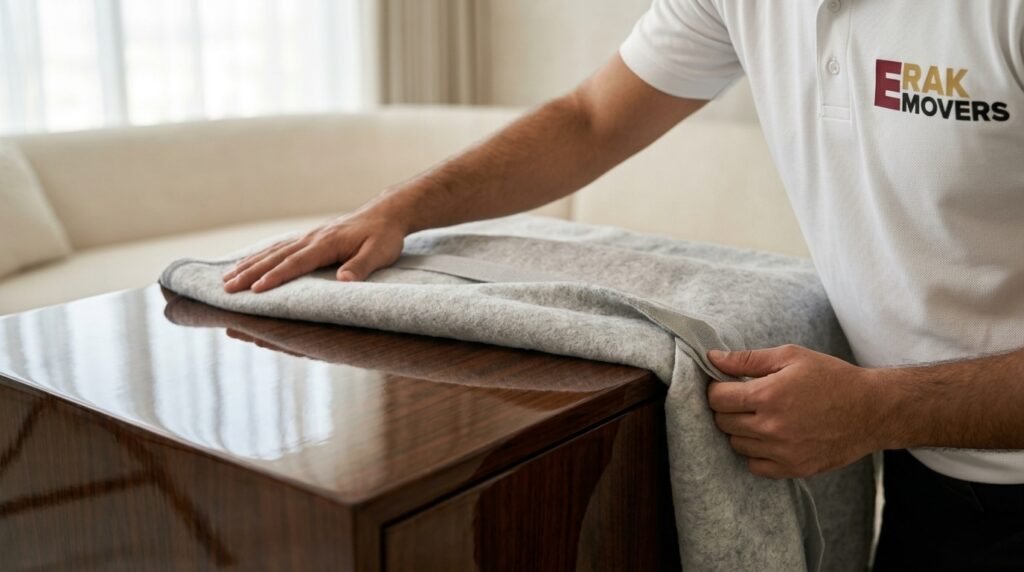
- Furniture blankets
- Stretch film
- Protective covers
- Specialist supports
- Sealing and labelling supplies
Each serves a different purpose. For example plastic film holds wrapping together, but provides little cushioning by itself.
| Material category | Supplies | Main purpose |
|---|---|---|
| Cartons | Standard boxes, reinforced cartons, dividers | Contain and separate household items |
| Wrapping paper | Clean packing paper, suitable acid-free tissue | Wrap individual items and separate surfaces |
| Cushioning | Bubble wrap, foam sheets, crumpled paper | Reduce movement and cushion contact |
| Furniture blankets | Clean padded blankets | Protect furniture against rubbing and minor knocks |
| Stretch film | Hand-applied wrapping film | Secure suitable outer protective layers |
| Protective covers | Mattress bags, sofa covers | Help keep upholstery and bedding clean |
| Specialist supports | Corner guards, fitted inserts, crates | Protect vulnerable edges and support delicate pieces |
| Sealing and labelling | Packing tape, markers, labels | Close cartons and identify contents and destination rooms |
Choose clean, dry cartons with intact seams. Reinforced cartons are useful for fragile contents, but the box’s stated load capacity still matters.
Avoid putting adhesive tape directly on furniture finishes. For delicate surfaces, confirm which material can safely touch the item before applying an outer layer. More wrapping does not compensate for an unsuitable contact material or an unsupported load.
How Many Cartons Does Each Property Size Need?
A lightly furnished studio might need around 15–25 standard cartons, while a three-bedroom villa could need roughly 60–100. These are illustrative planning allowances, not measured RAK averages or guaranteed quantities.
They assume a full household pack using a mixture of small, medium and large cartons. Wardrobe boxes, fitted television cartons and custom crates are additional.
| Property type | Illustrative standard-carton allowance | What may increase the count |
|---|---|---|
| Studio apartment | 15–25 | Extensive kitchenware, books or clothing |
| One-bedroom apartment | 25–40 | Full cupboards and a separate workspace |
| Two-bedroom apartment | 40–60 | Children’s belongings and additional linen |
| Three-bedroom apartment | 55–85 | Several occupied bedrooms and stored collections |
| Three-bedroom villa | 60–100 | Utility rooms, outdoor supplies and storage cupboards |
| Four-bedroom villa | 80–130 | Family collections, hobbies and additional storage |
| Five-bedroom villa or larger | 110–180+ | Multiple storage areas and densely furnished rooms |
Bedroom count provides only a starting point. Two people with several bookcases may require more small cartons than a larger household with fewer possessions.
The size mix also changes the total. Replacing medium cartons with smaller ones increases the number of boxes without increasing the amount being moved.
Before ordering, inspect every cupboard, drawer and storage area. Separate items being sold, donated or discarded. Then ask the mover to confirm the allowance against the actual inventory.
Which Carton Sizes Are Used and For What
Small cartons suit dense belongings, medium cartons suit mixed household contents, and large cartons suit lightweight, bulky items. Select the box according to both weight and shape.
The dimensions below are examples for planning. Suppliers use different specifications, so check the actual dimensions and load rating before purchasing.
| Carton type | Example dimensions, L × W × H | Suitable contents |
|---|---|---|
| Small | 35 × 25 × 30 cm | Books, files and compact non-fragile items |
| Medium | 45 × 35 × 35 cm | Toys, folded clothing and wrapped kitchen items |
| Large | 60 × 40 × 40 cm | Duvets, pillows and lightweight linen |
| Reinforced dish carton | Varies by supplier | Individually wrapped crockery and glassware |
| Wardrobe carton | Varies by height and rail capacity | Hanging clothing |
| Fitted specialist carton | Sized around the item | Televisions, mirrors and framed pieces |
Do not fill a large carton with books simply because they fit. Divide dense contents between smaller boxes and keep each load comfortably manageable within the carton’s rating.
Fragile items need individual wrapping and cushioning between them. Fill empty spaces so the contents cannot shift, but avoid forcing the lid shut.
Seal the base securely with packing tape across the main seam and supporting edges. Label the top and one side with the room, brief contents and box number. “Kitchen — Glasses Box 12” is more useful than “Fragile” alone.
Which Specialist Materials Are Required and When
Artwork, marble, mirrors, electronics and unusually delicate furniture may need fitted protection or structural support. Ordinary cartons and loose bubble wrap are not suitable for every item.
Discuss these categories during the survey:
- Artwork and framed pieces: Use surface-compatible protective layers, corner protection and a fitted outer container. High-value or delicate works may require specialist assessment and crating.
- Mirrors and glass panels: Protect edges, cushion the item and use an appropriate rigid container or support system.
- Marble and stone tops: Plan support, handling orientation and any removal from the base. Padding alone cannot prevent damage caused by bending or unsupported weight.
- Televisions and monitors: Use the original packaging with intact inserts where available, or a suitable fitted alternative. Keep pressure away from the screen.
- Computers and electronic components: Use fitted cushioning and appropriate anti-static packaging where required for exposed components.
- Antiques and sensitive finishes: Confirm suitable contact materials, loose components and handling points before wrapping.
A crate should be designed around the item and its transport needs. An oversized timber box with poor internal support can still allow damaging movement.
Share photographs and dimensions when arranging fragile-item moving services, and identify any existing damage before packing begins.
What Wardrobe Boxes and Mattress Bags Are For
Wardrobe boxes carry hanging clothes without folding, while mattress bags help protect mattresses from dirt during handling and transport. Both solve specific packing problems.
A wardrobe carton contains a hanging rail. Check its height against long dresses, coats or abayas, and stay within the rail and carton capacity. Avoid filling the base with shoes or other heavy belongings unless the box is designed for that use.
Ordinary folded clothing can travel in standard cartons or suitable luggage. Reserve wardrobe boxes for garments that benefit from remaining on hangers.
Choose mattress bags that fit the mattress dimensions and depth. Pack only a clean, dry mattress, and remove the transport covering promptly when appropriate at the destination.
The bag is a protective cover, not a lifting handle. It also does not prevent bending or crushing, so handling and vehicle placement remain important. A transport bag should not automatically be treated as suitable packaging for long-term storage.
Whether to Buy Materials or Have the Mover Supply Them
Buying supplies gives you control over gradual self-packing; mover-supplied materials simplify selection and coordination. Compare the complete scope rather than assuming either option always costs less.
| Consideration | Buy materials yourself | Have the mover supply them |
|---|---|---|
| Selection | You choose carton sizes and protection | Materials can be selected during the survey |
| Packing labour | Usually your responsibility | Included only where the booked scope says so |
| Shortages | You arrange additional supplies | Confirm how additional materials are handled |
| Specialist items | Require separate planning | Can be assessed with the handling requirements |
| Leftover supplies | You keep, return or dispose of them | Ownership and returns depend on the agreement |
| Waste removal | Usually arranged separately | Confirm whether removal is included |
For self-packing, calculate the cost of cartons, paper, cushioning, tape, delivery and any specialist containers. A cheap carton bundle may become expensive if it lacks the sizes you need.
For professional packing, ask whether the price includes materials, labour, unpacking and debris removal. Request approval terms for anything outside the agreed inventory.
The UAE Government’s consumer-protection guidance explains consumers’ rights to accurate information and suppliers’ obligation to provide a dated invoice identifying the goods or services, price and quantity. Keep the written quotation and invoice together.
RAK E Movers states that materials are included in its packing service. Confirm your household’s requirements through its packing and unpacking service before buying duplicate supplies.
What to Do With Packing Materials After the Move
Separate reusable supplies from waste, and confirm collection arrangements before the crew leaves. Debris removal depends on the booked service, particularly when unpacking continues after delivery.
Keep suitable television inserts and specialist packaging if you have space. Flatten clean, undamaged cartons for reuse, and return any borrowed blankets or reusable equipment as agreed.
RAK Municipality’s Sustainable Community Guidelines identify paper and cardboard among recyclable materials and support separation of recyclables from general waste. Ask building management or the waste provider which materials the local collection accepts.
Separate cardboard from plastic film and foam rather than assuming everything belongs in the same recycling container. Keep corridors, stairs and shared exits clear while awaiting collection.
Before discarding packaging from a damaged item, photograph it and check whether it is needed for the mover’s assessment. Once checks are complete, arrange removal so unpacking ends with usable rooms and clear access.