
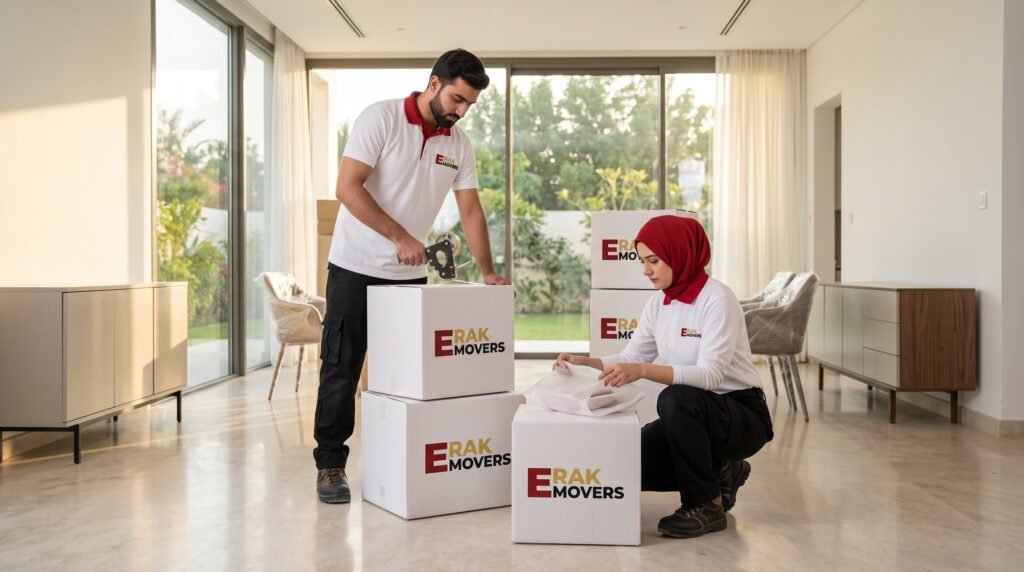
A phone quote can sound reassuring because it gives you a number in a few minutes. You say, “three-bedroom villa,” answer a few questions, and the mover gives you a price. The problem is that the number may be based on the label of the property rather than the amount of work inside it.
For a relocation in Ras Al Khaimah, the real workload depends on belongings volume, packing, dismantling, access, labour time and vehicle capacity. A phone call can collect part of that information, but it cannot see the move.
What Does a Phone Quote Actually Measure?
A basic phone quote usually measures little more than bedroom count and a short description of the property.
The caller may ask whether you are moving from an apartment or villa, how many bedrooms you have and where you are going. Those questions are useful, but they are still proxies. A “four-bedroom villa” is a property description. It is not a measurement of furniture, cartons or cubic metres.
Two four-bedroom homes can require completely different moving plans. One may contain basic furniture and a modest number of boxes. Another may have six wardrobes, two living areas, garden furniture, children’s equipment, a full store room and years of items in the garage.
A proper pre-move survey gives the mover a clearer picture of the belongings, access conditions, packing requirements and any items that may need special handling before the final price is confirmed. The FIDI Global Alliance also recognizes the pre-move survey and related quotation as connected parts of a professional moving process, helping ensure the estimate is based on the actual requirements of the move rather than bedroom count alone.
Why Bedroom Count Is a Poor Proxy for Volume
Bedroom count is a poor proxy because two identical properties can hold very different amounts of furniture and personal belongings.
Occupancy length is one reason. Someone who moved into a villa recently may still have a fairly light household. A family that has lived in the same property for years may have filled wardrobes, storage cupboards, spare rooms and the garage without noticing how much volume has accumulated.
Family size changes the calculation too. A three-bedroom home occupied by one couple does not resemble a three-bedroom home occupied by two adults and three children. Beds, desks, bicycles, toys, bookcases, clothing and school items all add volume even though the bedroom count stays the same.
Lifestyle matters as well. One household may own garden furniture, gym equipment and several large televisions. Another may own almost none of these.
So “How many bedrooms?” should never be the last inventory question. It describes the shell of the home, not the load going into the truck.
Which Contents a Phone Quote Cannot See
A phone quote cannot see contents hidden in the parts of a home people often forget to mention.
Four areas regularly create the biggest blind spots:
Store room: Suitcases, shelving, tools, spare appliances and stacked cartons can turn a small room into a meaningful part of the load. As an illustrative planning allowance, a half-full to packed store room might add roughly 2–5 m³.
Garage: Bicycles, cabinets, toolboxes, sports gear, freezers and boxed goods can take far more space than expected. A used garage may add around 3–8 m³ or more.
Balcony cupboard or outdoor storage: Cleaning equipment, folded chairs, tools and boxes may add another 0.5–2 m³.
Loft or upper storage area: Luggage, decorations and archived cartons may add roughly 1–4 m³ where such storage exists.
These are examples, not fixed room-volume standards. The point is that unseen contents have real volume. A mover who does not know these spaces exist cannot accurately allow truck space, cartons or labour for them.
This is often the answer behind “why did my moving quote change?” The home did not suddenly become larger. The original estimate simply failed to capture belongings that were already there.
How Much a Phone Quote Typically Understates a Villa Move

There is no reliable UAE-wide dataset showing one universal percentage by which every phone quote understates a villa move. So an exact “industry average” would be misleading.
A more useful way to look at it is uncertainty.
For a villa priced only from bedroom count and a short phone description, a practical planning-risk band is roughly 15–30% of the assumed contents volume, with a larger gap possible when a garage, store room, outdoor furniture or other areas were never discussed. This is not a published UAE benchmark; it is a planning allowance for missing information.
If a mover assumes the load is about 30 m³, a 15% miss is 4.5 m³. A 30% miss is 9 m³. That difference can affect vehicle choice, loading time, crew hours and packing materials.
So, are moving quotes accurate? They can be—but only when the information behind them is accurate. A quote built on incomplete information can only be as reliable as the assumptions used to create it.
What Happens When the Truck Is Too Small
When the vehicle is too small, the crew may have to return for a second load.
Imagine the team arrives expecting a normal three-bedroom move. Once packing begins, they discover a full garage, large outdoor furniture, extra wardrobes and dozens of boxes that were never mentioned. The truck fills before the property is empty.
Now the job has changed.
A second trip means more driving, loading and unloading, fuel use and crew time. If the job runs beyond the planned hours, overtime may also become an issue. The customer then feels that the movers quoted low then charged more. The mover may say the inventory was larger than described.
Often, the real failure happened before moving day: nobody built a proper inventory before the price was accepted.
There is also a scheduling problem. A vehicle or crew planned for another job later in the day may no longer be available. Even when extra charges are avoided, the move can take much longer than expected.
Accurate vehicle planning therefore affects cost, timing and whether the relocation can be completed in one organised run.
When a Virtual Survey Is Accurate Enough
A virtual survey is accurate enough for many studios and one-bedroom apartments when the property is straightforward and every area is shown clearly.
A video walk-through lets the surveyor see furniture, appliances, wardrobes, cartons and access points instead of asking the customer to remember everything. It can reveal whether a sofa needs dismantling, whether cupboards are full and whether there are bulky items that need extra handling.
Video surveys are now commonly used by removal companies as a way to inspect the home before quoting.
For a lightly furnished studio or one-bedroom apartment, that may provide enough information for a reliable written estimate. As property size and storage complexity increase, an in-person survey becomes more valuable.
Villas, large apartments, homes with garages, multiple storage areas, outdoor furniture, specialist items or unusual access are harder to assess through a quick call.
The difference is simple: a virtual survey shows the contents. A phone quote asks the customer to describe them.
What to Insist On Before Accepting Any Quote
Before accepting any quote, insist on a written, itemised document based on a proper survey or detailed visual inventory.
Check that it states:
- the moving locations and property type;
- the estimated contents volume or detailed inventory;
- the vehicle or vehicles planned;
- expected crew size;
- packing and unpacking included;
- dismantling and reassembly included;
- packing materials included;
- charges for stairs, long carries or difficult access;
- specialist items needing separate handling;
- when an extra trip or overtime can be charged;
- anything specifically excluded from the price.
A pre-move survey normally assesses more than belongings volume; it can also capture access, packing needs and other conditions that affect the moving plan.
The safest quote is not necessarily the cheapest one. It is the quote built from the clearest understanding of what is actually being moved.
Before booking movers in Ras Al Khaimah, make sure someone has seen the load—through a thorough virtual survey or an in-person visit—rather than relying on bedroom count alone. The next question is what a proper pre-move survey should record, because that is what turns a rough estimate into a moving plan you can compare properly.
Contact us to arrange a move assessment before accepting a final quote.