
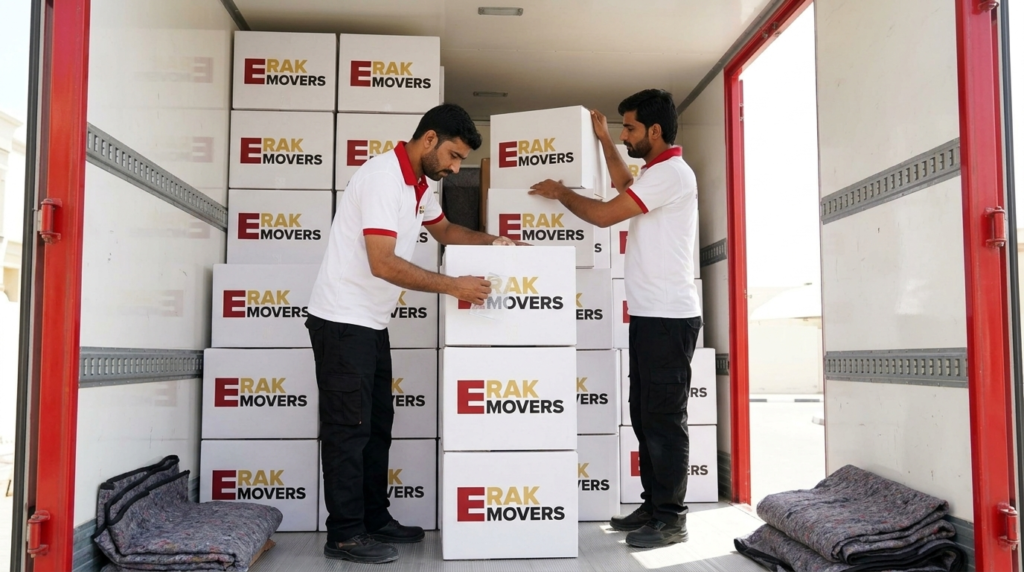
A clearly labelled box is only useful if someone can read it. Write “Kitchen” on the lid alone, and the instruction disappears as soon as another carton sits on top. At the new home, that can mean unnecessary lifting, misplaced boxes and a search for everyday essentials.
Knowing how to label moving boxes helps keep a Ras Al Khaimah move organised from packing to delivery. This guide covers label placement, room names, carton numbers, colour coding and priority markings, with a printable template to keep the system consistent.
How Should Moving Cartons Be Labelled?
Label every carton on all four vertical sides with its origin room, destination room, contents summary and unique carton number. Make the destination most prominent. Add handling and opening-priority instructions where needed, and repeat the details on the lid as an optional extra.
Four-side labelling gives the crew more opportunities to identify a box when it turns during loading or faces a different direction at delivery. It does not make every label visible inside a full truck, but it reduces the need to rotate cartons just to read them.
Use this sequence:
- Choose destination room names
- Assign a carton number
- Write a short contents summary
- Repeat the information on four sides
- Add relevant handling instructions
- Enter the carton on your inventory
Use a thick, dark marker on a light surface. Place labels on clean, dry cardboard, away from seams, handles and areas likely to be covered by straps.
Cross out old delivery labels and previous room names on reused cartons. Two conflicting destinations can be worse than one missing label.
Why Top-Face Labelling Fails
Top-face labelling fails because another carton can cover the entire instruction. The label may look clear while the box sits on your kitchen floor, then become unreadable once the load is stacked.
The same problem continues after unloading. If several cartons are placed together against a wall, only their exposed sides may be visible.
| Label placement | What happens when cartons are stacked |
|---|---|
| Lid only | The label disappears beneath the carton above |
| One side | The marked face may point towards a wall or another box |
| Two adjacent sides | Visibility improves, but the carton can still face away |
| All four vertical sides | Any exposed vertical face carries the same identification |
The four-side rule is a practical packing method, not a legal requirement. It also does not replace careful stacking, suitable cartons or protective materials.
Ask the crew to keep an identified face outward where practical when placing boxes at the destination. For a tower apartment in Al Marjan Island, this can help you distinguish rooms without repeatedly moving cartons around a limited unloading space.
What Information Should Each Label Carry?
Every label should carry four main fields: origin room, destination room, contents summary and carton number. Together, they explain where the box came from, where it belongs, what it contains and how to check it against the inventory.
| Field | Example | Why it helps |
|---|---|---|
| Origin room | Old kitchen | Helps you trace where the contents were packed |
| Destination room | Kitchen — ground floor | Tells the crew where to place the carton |
| Contents summary | Dinner plates and bowls | Helps you find items without opening every box |
| Carton number | 014 | Connects the physical box to your inventory |
The destination room should be the largest text. Placement at the new property is the immediate decision during unloading.
If you are moving from an apartment in Al Nakheel to a villa in Mina Al Arab, contents from one old room may be divided between several new rooms. Pack separate destination groups rather than labelling every box with its old location.
Keep sensitive details off the outside. “Office files” is usually enough; account numbers, document contents and declared values belong in your private records.
When arranging packing and unpacking services in Ras Al Khaimah, share the room names and labelling system before the crew starts.
How Do You Number Cartons for Inventory Verification?

Use one continuous numbering sequence across the move. Start at 001 and assign each new carton the next available number. Repeat that number on every label attached to the same box.
Do not restart at 001 for each room unless you also use a unique room prefix. Several boxes marked “001” make delivery checks unnecessarily difficult.
Follow these steps:
- Create a master carton list
- Reserve numbers if several people are packing
- Record each sealed carton
- Update changes immediately
- Check numbers during delivery
- Investigate gaps before completing the walkthrough
A basic list might look like this:
| Carton | Destination | Contents | Priority | Delivery check |
|---|---|---|---|---|
| 001 | Kitchen | Serving dishes | Later | Pending |
| 002 | Bedroom 1 | Bed linen | Today | Pending |
| 003 | Office | Files and stationery | Later | Pending |
| 004 | Kitchen | Breakfast essentials | First | Pending |
The total alone is not enough. Receiving 30 cartons does not establish that the correct 30 cartons arrived. Matching their numbers gives you a more useful check.
Keep the inventory with your quotation, invoice and handover notes. The UAE Government’s consumer protection guidance explains that suppliers must provide a dated invoice identifying the business, service and price. Your carton list adds a separate record of the belongings involved.
How Does Colour Coding Supplement Written Labels?
Colour coding helps people recognise destination groups quickly, but the room name must remain readable. Colours can look similar in poor lighting, and not everyone distinguishes them equally well.
Use a small, consistent set:
| Colour | Destination |
|---|---|
| Blue | Kitchen |
| Green | Living room |
| Yellow | Bedroom 1 |
| Orange | Bedroom 2 |
| Purple | Office |
Share the key with everyone packing and unloading. Place matching room signs inside the new property, using removable materials that will not damage the finish.
Do not use the same colour to mean both “Kitchen” and “Fragile.” Keep room colours separate from handling instructions.
For larger homes, written floor information remains essential. A green label cannot tell the crew whether “Living room” means the downstairs family area or an upstairs sitting room.
How Do You Mark Fragile and Priority Cartons?
Mark handling requirements and opening priorities as separate instructions. “Fragile” tells the crew how the carton needs to be handled; “Open first” tells you when its contents are needed.
Useful markings include:
- FRAGILE: For cartons containing breakable items.
- KEEP UPRIGHT: With matching upward arrows where orientation matters.
- HEAVY: To alert handlers to an unusually heavy carton.
- OPEN FIRST: For immediate essentials.
- OPEN TODAY: For items needed after the first essentials.
- OPEN LATER: For contents that can remain packed.
- DO NOT STACK: Where specifically required and agreed with the crew.
A fragile label cannot compensate for poor cushioning. Likewise, a heavy label does not make an overloaded carton suitable to lift.
Identify priority boxes before loading. Ask for accessible placement, but let the crew determine the safe loading position. Loading an essentials carton last is useful only when it fits the overall load safely.