
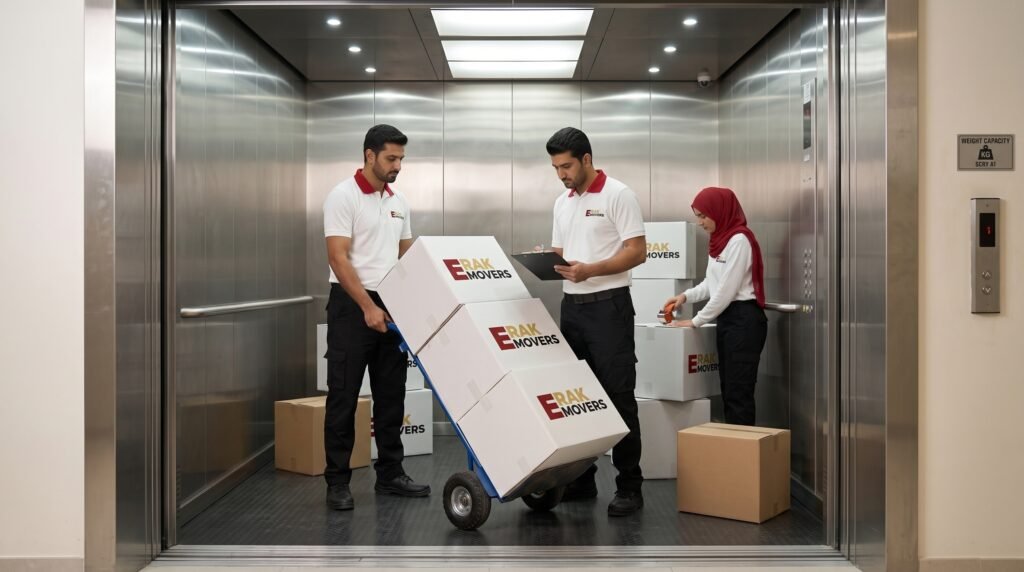
Furniture fits a freight lift only when it clears the entrance, corridor turns, lift doorway, cabin, and destination doorway. Width, height, turning space, packed dimensions, weight and building rules determine whether it can travel intact.
What Are Typical Freight Lift Dimensions in Ras Al Khaimah Towers?
Freight lifts in Ras Al Khaimah towers usually provide clear door openings around 0.9–1.2 metres wide and 2.0–2.2 metres high, cabins roughly 1.1–1.6 metres wide by 1.8–2.4 metres deep, and rated capacities from 1,000 to 2,500 kg. Treat these figures as planning bands, not guaranteed building specifications.
| Lift category | Clear door width | Clear door height | Internal width | Internal depth | Internal height | rated load |
|---|---|---|---|---|---|---|
| Compact residential service lift | 900–1,000 mm | 2,000–2,100 mm | 1,100–1,400 mm | 1,800–2,100 mm | 2,100–2,400 mm | 1,000–1,350 kg |
| Standard tower freight lift | 1,100–1,200 mm | 2,100–2,200 mm | 1,400–1,600 mm | 2,200–2,400 mm | 2,400–2,500 mm | 1,600–2,500 kg |
| Large goods or project-specific lift | 1,200–2,500 mm | 2,200–2,500 mm | Configuration-specific | Configuration-specific | Up to 2,500 mm | 2,500–4,000 kg |
These are planning configurations, not a Ras Al Khaimah statutory size.
The Schindler 2600 freight-lift specification lists 1,000–4,000 kg capacities, 800–2,500 mm door widths, and 2,000–2,500 mm door heights while Dubai Health Authority guidance gives 1,600 × 2,200 mm cabins, 1,200 × 2,200 mm doors and 2,500 kg capacity for healthcare goods lifts; this is not a residential rule.
Obtain actual dimensions and posted load from management. The smallest opening on the route controls the move.
How to Measure Your Building’s Freight Lift
To measure the lift, record the doorway, cabin and every approach turn, then measure furniture in its packed position. Arrange access with management, never obstruct doors, interfere with sensors or enter restricted areas.
Here are 7 steps to measure your building’s freight lift:
- Confirm the specification
- Measure the clear opening
- Measure the cabin
- Measure the approach
- Measure the item as moved
- Apply a working margin
- Presented item width + 50 mm ≤ clear door width
- Presented item height + 50 mm ≤ clear door height
Passing these equations means “possible,” not “confirmed.” The item must also rotate into the cabin, fit its footprint, and remain below the load limit.
Which Furniture Fits a Standard Freight Lift?
Standard freight lifts accommodate most chairs, appliances, modular seating and disassembled bed frames, while long sofas, rigid mattresses and wardrobes need checking. This table assumes a 1,100 × 2,100 mm door and 1,500 × 2,300 mm cabin; substitute your measurements.
| Furniture item | Likely result | Controlling check |
|---|---|---|
| Dining chair or office chair | Fits assembled | Stacked width and safe handling |
| Armchair | Usually fits | Narrowest rigid width |
| Two-seat sofa | Often fits angled | Length, arm height and door diagonal |
| Three-seat sofa | Measure first | Frame length, depth and cabin rotation |
| Sectional sofa | Modules fit; whole unit does not | Connector separation and module size |
| Single or double mattress | Usually fits tilted | Flexibility, thickness and cabin height |
| Rigid king mattress | Uncertain | Door diagonal and permitted bending |
| Bed frame | Fits after disassembly | Longest rail and headboard dimensions |
| Wardrobe | Usually disassemble | Carcass width, height and panel length |
| Dining table | Usually remove legs | Top width and turning radius |
| Standard refrigerator | Usually fits upright | Packed depth, door width and cabin height |
| Washing machine | Usually fits | Packed width and trolley clearance |
| Safe or piano | Specialist assessment | Total weight, point load and sill capacity |
Item names do not determine fit. A compact three-seat sofa may fit where a deep two-seat recliner fails. Measure rigid handles, arms, feet and packaging.
Which Furniture Does Not Fit and Must Be Disassembled?
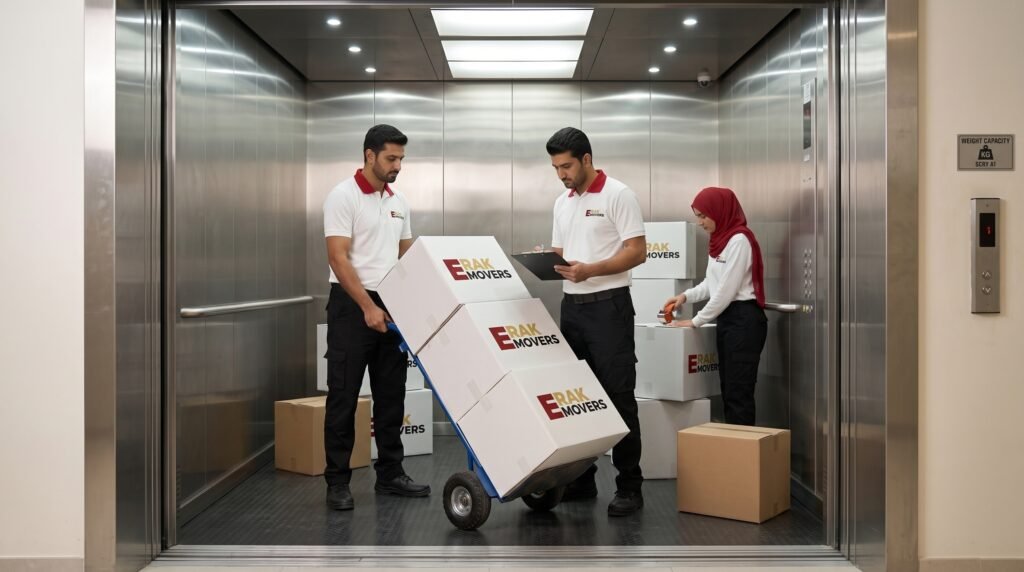
4 categories commonly fail the doorway or turning-space test and require disassembly:
- Large cabinet furniture
- Assembled frames
- Long upholstered furniture
- Oversized specialty items
Disassembly should follow the construction:
- Bag and label hardware
- Protect panels individually
- Document reassembly points.
RAK E Movers’ furniture movers in Ras Al Khaimah can assess dismantling during the inventory survey.
How Diagonal Clearance Changes What Fits
Diagonal clearance allows longer items than the door width suggests because a sofa or panel can enter tilted. For a rectangular opening:
- Opening diagonal = √(door width² + door height²)
A 1.1 m × 2.1 m opening has a diagonal of √(1.1² + 2.1²) = 2.37 m. A 2.2 m sofa may therefore pass lengthwise on an angle, provided its depth and rigid cross-section clear the opening.
Cabin floor diagonal is calculated as:
- √(internal width² + internal depth²).
A 1.5 m × 2.3 m floor gives 2.75 m.
Neither diagonal guarantees fit:
- The item needs a continuous three-dimensional path through the doorway.
- Enough lobby space for tilting and enough cabin room to rotate without touching doors.
- lights or controls.
What Happens to Items That Fit Neither the Lift Nor the Stairwell?
Items that fit neither route require partial dismantling, external hoisting or a revised plan. First measure the stair flight width, landing dimensions, headroom, handrails and every turn. Never assume stairs are an alternative simply because they look wider.
If approved dismantling cannot reduce the item, management must approve the next method. Options include:
- Authorised door removal
- Lifting through a suitable balcony or window with a licensed team
- Using a crane where permits allow.
External lifting requires a method statement, certified equipment, an exclusion zone and facade protection.
If the building prohibits hoisting, the practical options are storage, specialist workshop dismantling, returning or replacing the item, or rescheduling until an approved route exists. Movers should never improvise with ropes, overload a passenger lift or force furniture through a protected doorway.
How Lift Weight Limits Affect Loading Sequence
Weight limits constrain how many cartons, movers and handling tools travel per trip. The posted capacity covers everything inside the car, not cargo alone.
Usable goods payload = posted capacity − crew weight − trolley and equipment weight.
For a 1,600 kg lift carrying four 85 kg movers and a 40 kg trolley:
- 1,600 − (4 × 85) − 40 = 1,220 kg maximum goods payload
If management sets a lower move-day limit, that lower figure controls. Calculate the weight-based minimum trips as:
- Trips = ceiling(total goods weight ÷ usable goods payload)
A 1,800 kg load with 1,220 kg usable payload needs at least ceiling(1,800 ÷ 1,220) = 2 trips by weight. In practice, furniture volume and safe spacing usually create more trips.
Load heavy items with weight distributed across the floor, and keep bulky furniture in separate trips. A safe or piano needs approval for point load, trolley wheels and door-sill loading even when total weight is below capacity.
Confirm these 3 things before your freight lift reservation:
- Dimensions
- payload
- Route
Once you have confirmed it, you are good to reserve the freight lift for enough trips rather than compressing the move into an unsafe slot.